

Two years ago I laid 24 of these tiles on the concrete slab in my garage and called it a training floor. I want to give you the honest version of how that went, because almost everything I read before buying was written by somebody who had owned them for a weekend. The short version: they are still down and I would buy them again. The longer version involves seam creep, a foam smell that fades, a left knee that notices every millimetre, and one specific job these ProsourceFit mats do better than anything else I have tried on a garage floor. I run a small kickboxing and jiu-jitsu club in Columbus, Ohio, and this is the review I wish somebody had handed me before I spent the afternoon on my hands and knees.
So here is the framing. This is not a first-week impressions piece. It is what I know after two winters, a few hundred early morning sessions, a rotating cast of students who have borrowed the space, and one 12-year-old son who uses it for his own drills. I am going to tell you where the ProsourceFit puzzle mats hold up, where they annoy me, and the exact jobs I will not ask them to do no matter how good the listing copy is. If you want the answer before you settle in: they are very good at what they were built for, and they are not a substitute for proper martial arts mats. Most of the frustration people have with a product like this comes from asking it to be the second thing.
The Quick Verdict
A genuinely useful 24 square feet of half-inch EVA for footwork, bag work and stretching. Not a throwing surface, not a permanent floor, and the seams need a monthly look.
Amazon Check Today's Price →The floor I would lay down again on a garage slab
Half-inch EVA tiles, 24 by 24 inches each, six to a pack with end borders for the outside edges. Two years on my concrete and still doing the job I bought them for.
Amazon Check Today's Price on Amazon →The First Thing Nobody Mentions: Seams
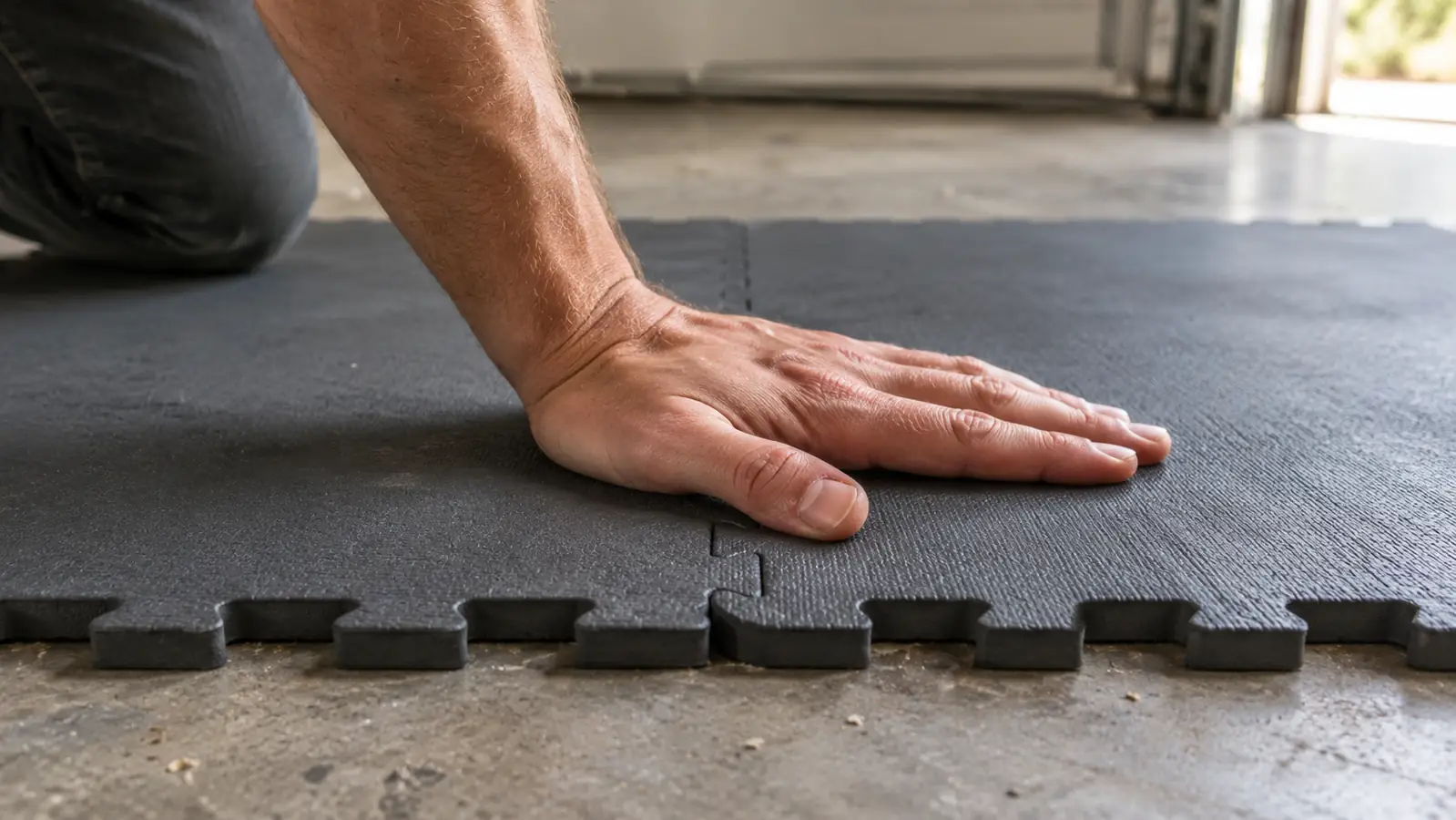
Every review talks about cushioning. Almost none of them talk about the seams, and the seams are where the whole ownership experience actually lives. A tile that measures 24 by 24 by half an inch is not a rigid panel. It is a piece of foam, and foam moves. In my layup, a rectangle 12 feet by 8 feet, the trouble spots were never in the middle. The middle gets loaded evenly, so it stays put. The trouble spots were the two long edges where people step in from bare concrete, and the corner nearest the hanging bag where I pivot most often on my back foot.
What happens is small and cumulative. A joint opens by a couple of millimetres, grit and dust get in, and by the end of a month that gap is wide enough that your bare heel catches it on a fast turn. It never feels dangerous. It feels sloppy, and sloppy is exactly what you do not want when you are drilling footwork that is supposed to be repeatable. The ProsourceFit tiles ship with end borders, the tapered edging pieces, and those genuinely help the outside perimeter because they ramp the step up instead of giving you a blunt foam cliff to stub a toe on. They do not do anything about the interior seams. Only you can.
The fix is boring and takes about four minutes. Once a month I walk the perimeter of the layout and press the joints back together with the heel of my palm, then sweep along the edge. When the mats were new I did this every week. Two years on, the joints have settled into each other enough that once a month holds. This is not a manufacturing defect and I would not file it as one. It is what interlocking foam does. Any mat that comes apart for storage will do the same thing, and the honest comparison is not against a glued floor, it is against the other puzzle mats in the same price band, and they all creep.

Assembly Is Closer to Two Hours Than Ten Minutes
The pack lists six tiles at 24 by 24 inches each, which works out to 24 square feet, and the whole thing is light enough that carrying it up the driveway is not a job. That weight is what tricks you into thinking the install is quick. It is not, if you want it to sit right for years. I swept the slab twice, left the tiles in the garage overnight so they had come up to something near room temperature, and started in the corner furthest from the door, working outward. Cold foam straight off a delivery truck is stiff and fights you on every joint.
The last row is where the job gets honest, because a garage slab is never square. Mine is off by maybe an inch and a half across 12 feet, which nobody would notice on bare concrete and everybody notices when you are laying a grid. I trimmed the final column with a utility knife, cutting from the underside in two passes rather than trying to push through half an inch of EVA in one. Measure that last row against the wall before you cut, not against the tile you just laid. I learned that on the second wall.
With 24 tiles, sweeping and trimming included, I was done in under two hours, and roughly 40 minutes of that was the trim and the fiddling at the borders. Six tiles straight out of the pack, no trimming, is a 10-minute job and if that is all you are covering, good. Just do not judge the material by how fast a small square goes together. The thing that makes this worth owning shows up over months, not minutes.
Half an inch of EVA will save your feet and your knees on a footwork day. It will not save your ribs on a throw, and no amount of marketing changes that.
Half an Inch Is a Real Limit, Not a Marketing Number
This is the part of the review that costs me the most goodwill from the manufacturer and is the most useful thing I can tell you. Half an inch of high-density EVA is a floor for standing on, moving on and lying on. It is not a floor for landing on. My left knee has a meniscus that has been unhappy since my twenties, and these tiles are the reason I can do 40 minutes of footwork and shadowboxing on concrete at 6am without paying for it the next day. That is a real, measurable improvement to my week and it is exactly what the mats are for.
What they are not for is anything where a body goes airborne and comes down hard, or where two bodies hit the floor. Throws, takedowns, sprawls that turn into a landing, ground grappling. At the club we have proper thick jiu-jitsu mats for that, and every single time I have let a student talk me into drilling a throw in the garage, I have regretted it. Not because the mat tore. Because half an inch does not absorb that much, and the person on the bottom finds out immediately. If you are buying these hoping to roll on them, you are buying the wrong product and you will find out the first night.
The same limit applies to weights, just less dramatically. It is non-skid, so a kettlebell set down between sets is fine and a bench with feet on the tile is fine. Dropping dumbbells, even light ones, will leave dents that never come back out, and EVA does not recover. I have a couple of shallow craters near the rack where a pair of 20 pounders came down harder than intended. They are cosmetic and they do not affect use, but they are permanent, and it is worth deciding before you lay anything heavy on top of a foam floor.
What I Liked
- Cushioning that makes 40 minutes of footwork on concrete genuinely comfortable, including on a bad knee
- Non-skid surface stays put under bare feet and socks, even during fast direction changes
- Interlocks and pulls apart easily, so a layout can be reconfigured or moved to another space
- End borders are included and make the outside edges safe to step on
- Wipes clean with a damp cloth and air dries without holding odour
- Light enough that one person can carry and lay a whole pack
Where It Falls Short
- Interior seams creep apart over time and need pressing back roughly monthly
- Half an inch is nowhere near enough for throws, takedowns or any hard landing
- Heavy dropped weights leave permanent dents in the foam
- Edges get chewed up if the floor is laid over an uneven or dirty slab
- A cold garage makes the tiles stiff and they need time to settle before the joints sit flat
Smell, Sweat, and What Nobody Warns You About
Out of the pack, these have a foam smell. Not chemical warfare, but noticeable, and if you lay them in a closed room the first night you will notice it every time you walk in. Mine aired out in about a week with the garage door open during the day. The listing says the foam contains no toxic phthalates, which is one of the reasons I was willing to put a kid on it, and I have no way to verify that beyond taking them at their word. What I can tell you is that two years in, there is no smell at all, even after a humid Columbus summer with the garage closed up.
Cleaning is where the material is easier than rubber. Sweat, dust, the fine grit that walks in off a driveway, all of it comes off with a damp cloth. I wipe the whole layout down after sessions where somebody has been barefoot and sweating, and I let it air dry rather than towelling it, which is what the care instructions call for. Do not soak it. Water that gets into a joint and sits under a tile is how you end up with a smell that no amount of wiping fixes. Damp cloth, air dry, done.
One thing I did not expect: dust. Foam tiles over concrete generate a surprising amount of light grey dust in the seams, more than a rubber floor does in the same space. It is not a defect, it is the slab under the tiles breaking down and working its way up through the joints. Sweeping the perimeter once a week keeps it in check. If you have asthma or you are fussy about a clean training space, budget for a sweep more often than you think.
What Actually Wears Out
Not the middle. After two years of daily use, the centre of my layout looks close to new. The texture on the surface has smoothed slightly in the two spots where I pivot most, which actually makes those tiles grippier with socks on and slightly slicker with bare sweaty feet. Nothing has cracked, nothing has delaminated, and no tile has failed at an interlocking nub. For a foam product that lives on a slab in a garage that goes below freezing in January, that is better than I expected.
The wear is concentrated at the perimeter and under the bag. The outer tiles take the step-on traffic from concrete and their edges round off and get nicked. Under the hanging bag, where the same spot gets loaded every session, the foam compresses and stays compressed, maybe a sixteenth of an inch. Both are cosmetic. Neither has changed how the floor performs, and I have not had to replace a single tile. The listing mentions a limited lifetime warranty, which I have never had cause to test, so treat that as a fact on the page rather than something I can vouch for.
What I Would Do Differently
Two things. First, I would have bought everything at once rather than adding a second pack six months later. Foam from a different production run can sit at a slightly different height, and mixing packs in one layout gives you a step you can feel with a bare foot. If you think there is any chance you will expand the area, buy the extra tiles at the start. Second, I would have marked the underside of the edge tiles with a Sharpie before laying them, because after two years of pulling the layout apart to sweep, I have lost track of which tile belongs on which edge, and the border pieces only fit the perimeter.
I would also have been more honest with myself about the space. Twelve by eight feet is enough for footwork, a bag and stretching. It is not enough for two people drilling. When a student comes over, one of us is standing on concrete. That is a space problem, not a ProsourceFit problem, but it is the kind of thing you only notice after you have laid the floor and started using it.
Who This Is For
You will get a lot out of these ProsourceFit tiles if you have a hard floor, a slab, or a carpet you want to protect, and you mostly stand up on it. Footwork drills, shadowboxing, bag work, stretching, bodyweight circuits, a kid doing karate practice in the basement. It is also a reasonable surface for a home gym that has a bench and a rack and does not involve dropping anything. Parents buy these for play areas for the same reason I bought them for a garage: half an inch of EVA takes the sting out of a hard floor without turning a room into a mat room. At roughly 40 adults and 20 kids through my club, the ones who get the most from a floor like this are the ones who want a defined space to move in and do not need it to be anything more.
Who Should Skip It
Skip these if you grapple, throw, or take falls anywhere in your training. Half an inch will not protect you and it will teach you bad habits about how hard a floor should feel. Skip them if you want a permanent floor that never needs attention, because the seams will ask for four minutes of your month, forever. Skip them if your slab takes on moisture, because foam over a damp floor is a smell waiting to happen. And skip them if you are planning to drop weights, because the dents are permanent and you will be annoyed every time you see them. None of that is a knock on the product. It is a knock on buying the wrong thing, which is the most common way people end up disappointed with a floor.
If your training happens standing up, this floor earns its place
Half-inch EVA, 24 by 24 inch tiles, six per pack, with end borders included. Two years of early mornings on my garage slab and nothing has cracked, delaminated or had to be replaced.
Amazon Check Today's Price on Amazon →