
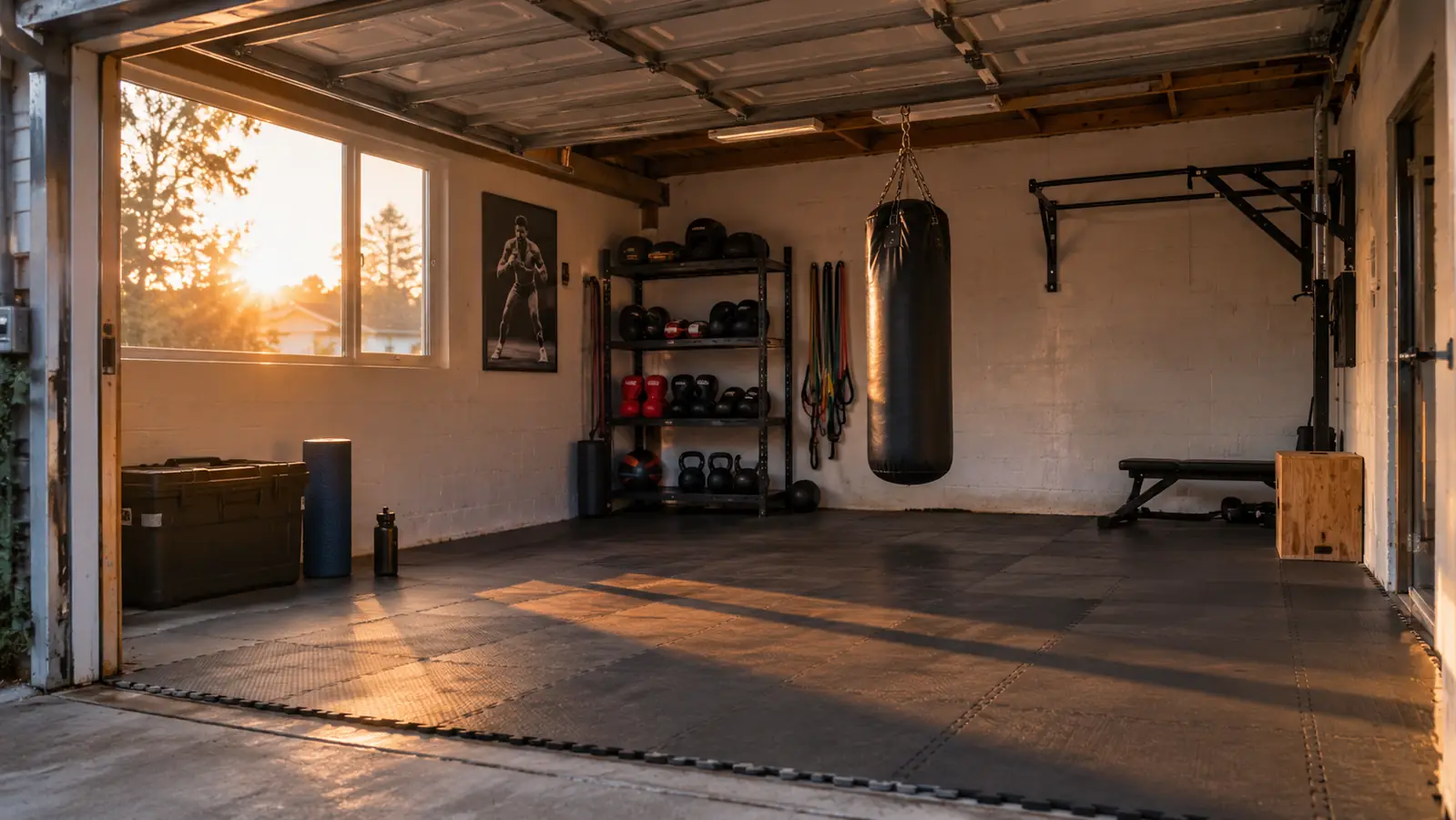
Concrete does not forgive a bad knee. The first morning I ran footwork drills on the bare slab of my garage, my left knee filed a complaint before the second round was over. That is why I bought the ProsourceFit puzzle mats, and it is the least interesting thing I can tell you about them two years later. What is worth telling you is where the tiles have flattened, which seam keeps catching the toe of my shoe, how the floor behaves when the garage swings from cold and damp in March to hot and humid in July, and what I actually do about all of it before the club opens at six.
I coach kickboxing and Brazilian jiu-jitsu out of a converted warehouse unit in Columbus, and the garage at home is where I train before anyone else shows up. Four or five mornings a week, plus stretching most evenings. My mat area is 24 tiles, about twelve feet by eight, laid straight onto the concrete. ProsourceFit sells these in sets of six tiles that cover 24 square feet, so my floor is four sets. Everything below is about that setup specifically: half-inch EVA foam, 24 inch squares, in an Ohio garage that goes from cold and damp to hot and humid inside the same season.
The Quick Verdict
A light, genuinely grippy surface that turns a garage slab into someplace you can move. Not a grappling mat, and the seams want ten minutes of attention a few times a year.
Amazon Check Today's Price →The half-inch tiles that made my garage slab trainable again
Four sets covers a twelve by eight foot area. Light enough to carry in one trip, dense enough that my knee stopped complaining about Monday mornings.
Amazon Check Today's Price on Amazon →How I've Used It
Two sets went down first, then two more a month later once I was sure I wanted the full twelve by eight. Laying them took one evening, including sweeping and scrubbing the slab first. The only part that annoyed me was the smell of new foam, which hung around for a few days before it faded. I left the garage door open and let them air out. The tiles press together by hand once you line the tabs up, and once a seam is seated it stays seated. Each six-tile set from ProsourceFit comes with end borders for the outside edge, which matters more than it sounds like it should. Without them the perimeter is a row of exposed puzzle tabs that catch socks and make the floor look like a project someone abandoned.
What happens on the mats: footwork drills, shadowboxing, bag rounds on the heavy bag that hangs over the far corner, stretching, and light technical drilling with a student who wants extra work before class. Bare feet mostly, wrestling shoes when my ankle is cranky. What does not happen on them: throws, takedowns, or anything where a body lands. I have 24 tiles of half-inch foam over concrete, and that is not a grappling surface. Throws happen at the club, on the thick jiu-jitsu mats, and they will keep happening there.
That distinction is the whole review, honestly. Judged as a grappling mat, this floor is a bad idea and I would tell you so to your face. Judged as what it actually is, a firm, non-skid surface that turns a garage slab into something you can pivot on, it has done its job for two years with almost no attention from me. The last twelve months are the stretch where I started paying attention, because that is when a foam floor either settles into place or starts coming apart at the edges. Mine did the first thing.
The routine has not changed much in two years. Warm up on the tiles, twenty to thirty minutes of bag work, then ten minutes of stretching on my back with my heels sliding out along the surface. In winter I train in a hoodie and the foam is cold for the first minute and fine after that. In summer the whole garage is a sauna and the surface gets damp. The mats have not cared either way, which is more than I can say for the heavy bag chain.

What Half an Inch Actually Means Underfoot
Half an inch does not sound like much, and it is not. The listing is careful about it: the tiles measure half an inch thick from the highest point of the texture, which means the low points between the raised pattern are thinner than that. What you get underfoot is a firm, dense surface with a small amount of give, not a soft one. At 185 pounds, dropping into a stance or landing a kick, I can feel the foam compress and push back. It is enough to take the sting out of concrete. It is not enough to make you forget the concrete is down there.
That firmness is exactly why it works for footwork. A soft mat rolls under you when you pivot, and pivoting is most of what a kickboxing stance does. These tiles are dense EVA foam and the surface grips a bare foot well enough that I have never had one slide out from under me mid-turn, wet or dry. The listing also notes the foam contains no toxic phthalates and offers it as an alternative to rubber crumb, which mattered to me for a floor where my twelve-year-old occasionally drills and where I am barefoot four mornings a week.
Where the thickness falls short is anything with a body in it. Falling on half-inch foam over concrete is closer to falling on concrete than people expect. I have taken a knee and an elbow setting up drills and felt all of it. If your training involves being thrown, landing, or working from the ground for long stretches, this is the wrong product and no amount of rearranging the tiles fixes that.
After two years the worst damage on the whole floor is a set of quarter-inch dents under the heavy bag, and those tiles still lock flat when I lift and re-seat them.
How They Held Up Over Twelve Months
The short version: better than I expected, worse in one specific spot. The tiles have not curled at the corners, which is the failure I was braced for after watching cheap foam floors in other people's garages. Nothing has slid. The interlocking tabs still hold. When a tile does work loose under the bag I walk over, press it back down with a heel, and forget about it for another month.
The place it has given up is the corner under the heavy bag. The bag hangs there and the load never moves, so the tiles beneath it have compressed into shallow dents that do not spring back. After two years you can see the depressions and feel them with a bare foot. It has not changed how the floor performs. The dents are maybe a quarter inch deep at the worst point, and if it bothered me I could swap those tiles to the wall side where nobody stands. I have not bothered.
The border strips deserve a mention because they are the part people forget to check in a review. Mine have stayed clipped to the outer tiles for two years, including along the edge where I drag a heavy bag stand across them. One strip popped loose when I caught it with a shoe early on. It pushed back on and has stayed on since. The perimeter edge is where a floor like this usually starts to look tired, and mine still reads as a finished rectangle.
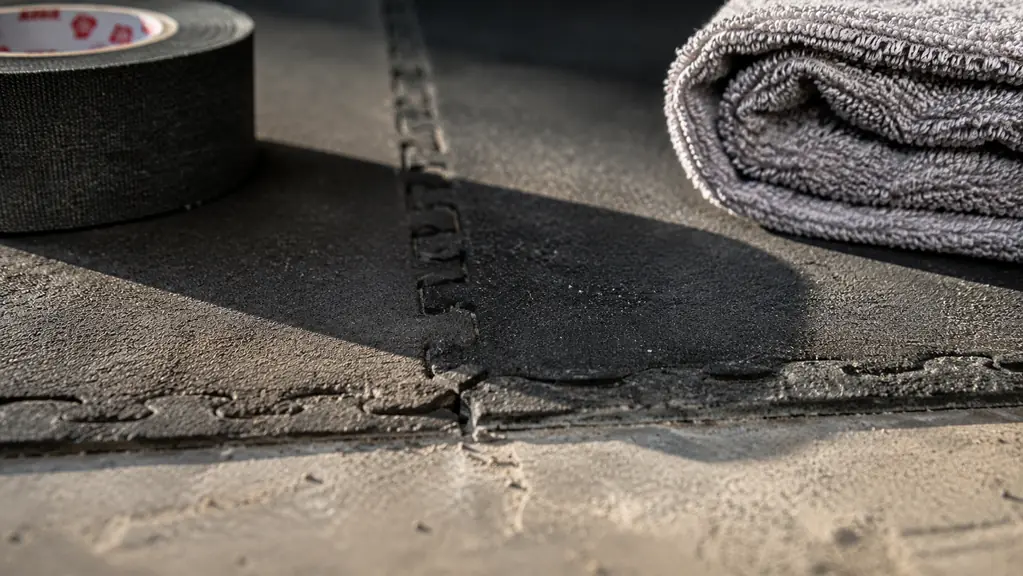
The seams are the other visible change. Dust, chalk, and whatever comes off a shoe collect in the lines between tiles, and after a few months the seams are obvious from across the garage. That is not damage, it is housekeeping, and a damp cloth handles the surface. The care instruction on the listing is air dry, which is worth following: I wipe the floor down and let it sit rather than putting anything else on it, and I have never had the foam go tacky or start flaking.
What I Liked
- Dense enough that footwork on concrete stopped bothering my left knee
- Tiles lock and stay locked, and nothing has slid under the heavy bag in two years
- Pulling up a section to clean or re-seat is a one-hand job at the listed five pounds per six-tile set
- End borders finish the outside edge so the floor looks like a floor and not a pile of tiles
- Wipes down with a damp cloth and air dries without going tacky
Where It Falls Short
- Not thick enough for takedowns, and I would not trust it for throws or hard falls
- Seams collect dust and chalk and need tape every few months
- Compresses under the heavy bag corner where the load never moves
- Scuffs from shoes and takes a mark from anything dragged across it
The Seams, the Sweat, and the Cleanup
A garage floor in Ohio sweats. Concrete pulls moisture when the season turns, and foam laid directly on it will hold that moisture underneath if you never lift it. Twice a year I pull the whole area up, sweep, wipe the slab, and lay it back down. That takes under an hour for 24 tiles and the floor goes back together the same way it came apart. That single habit is probably why the underside still looks like foam and not like something that has been growing in a dark place.
Sweat is the other reality. Bag rounds in July leave the surface wet, and wet foam gets slick in a way dry foam does not. I keep a towel at the edge of the mat and wipe down between rounds. Annoying, but true of every mat I have ever trained on. Chalk from grip work is worse. It works into the raised pattern and needs a damp cloth and some patience rather than a quick pass.
Every few months I tape the two seams that run through the middle of the work area, because those are the ones my feet cross most and the ones that open just enough to catch a toe. It is a five minute job with a roll of athletic tape, and it is the only maintenance the floor has ever asked of me.
What I'd Do Differently Setting It Up
Buy the whole area at once. I bought two ProsourceFit sets, waited a month, then bought two more, and spent that month with a floor that was three quarters finished and a stack of tiles leaning against the wall. There was nothing wrong with the second pair of sets. No fit problem, nothing I could point to. The problem was me and my own hesitation, and it cost me a month of training on a floor that was not done.
Lay it out on paper first. Twelve by eight is not an accident for me, it is what fits between the wall rack and the door with enough room to swing a bag without clipping it. Twenty-four tiles at 24 inches square, laid four wide and six long, gave me a clean rectangle with no cut tiles. If your space does not divide evenly by two feet you will end up with an awkward strip along one wall, and a border strip finishes an edge. It does not make a cut tile look intentional.
One more thing: give the foam a few days to stop smelling like new foam before you commit to training in a closed garage. Mine aired out fine and smells like nothing now, but that first week was noticeable, especially once the weather warmed up.
Who This Is For
This floor is for the person with a slab, a spare room, or a basement corner who wants to turn it into someplace they can move. Footwork, shadowboxing, bag work, stretching, bodyweight circuits, light drilling with a partner who is not trying to put you on the ground. It is also a good surface for a kid's practice space, which is how a large share of these tiles get sold. If what you need is a firm, grippy, non-skid surface that goes down in an evening and comes up just as easily when you move, ProsourceFit has been making this exact product for years, and mine has held up to two of them.
Who Should Skip It
If your training involves throws, takedowns, or falling, skip it and buy real mats. Half-inch foam over concrete is not a landing surface, and I would rather say that plainly than have someone take a hard fall on it because a review was too generous. Skip it too if you want a floor that never needs attention, because the seams and the bag corner ask for a few minutes a couple of times a year. And skip it if your garage takes on water. Foam that sits in standing water is finished, and no warranty language changes that.
Two years in, I would buy the same tiles for the same job
Footwork, bag work, stretching, light drilling. Twenty-four tiles, four sets, and a slab that stopped being a problem.
Amazon Check Today's Price on Amazon →