
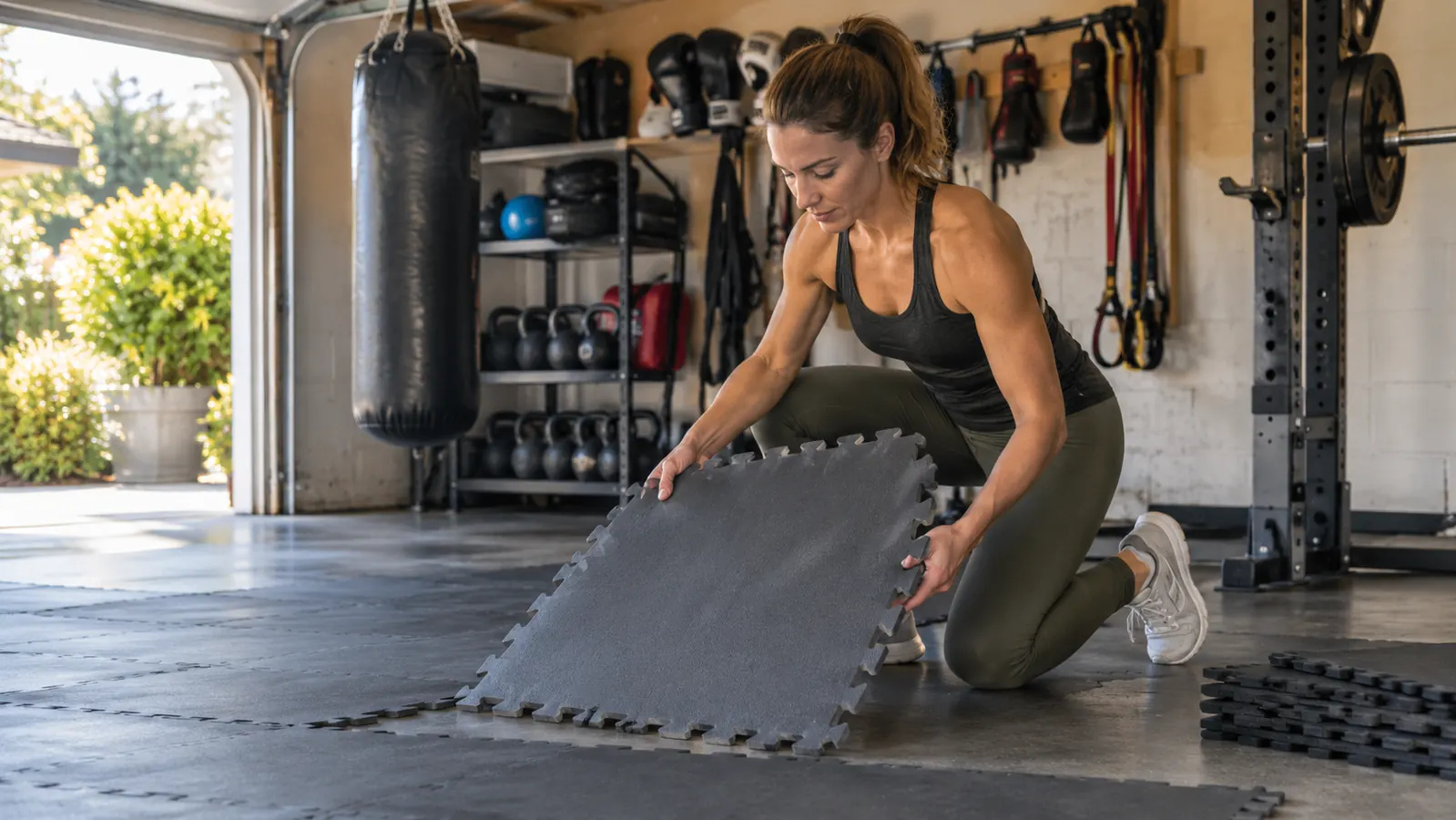
My left knee has a meniscus tear from competition days, and the floor of my garage is the first thing it complains about at six in the morning. I got the floor wrong twice before I got it right. Thin rubber that curled. A cheap roll that slid. The ProsourceFit puzzle mats I laid down two years ago are still down, and they are down because half an inch of EVA underfoot stops the concrete from being the hardest thing I train on. That is the whole argument. Everything below is detail.
Before the list, the boundary. These mats cover footwork, shadowboxing, bag work, stretching and light drilling in my garage. Throws and takedowns happen at the club, on the thick jiu-jitsu mats, and they will keep happening there. Hold that line in your head and these ten reasons will read as what they are, which is a description of a job and the tool that fits it.
The floor under the bag is the one you stand on longest
Half inch EVA, 24 by 24 inch interlocking tiles, six per pack with end borders. The same ProsourceFit set that has been down in my garage for two years.
Amazon Check Today's Price on Amazon →Cold concrete stops being the hardest surface in the room
Bare slab does not feel like a problem until you stand on it for forty minutes. Then it is the only thing you notice. I am not going to tell you foam fixes a bad knee, because it does not. What it does is remove the constant low shock of standing, shifting and stepping on a surface that never gives an inch. My sessions went from twenty minutes before the aching started to a full hour. That is a floor change, not a training breakthrough.

Half an inch is the right amount of give for standing work
Too thin and you may as well be on the slab. Too thick and you spend the session balancing. The ProsourceFit tiles measure 24 inches by 24 inches by 1/2 inch thick, measured from the highest point of the texture, and that lands in the useful middle for stance work, footwork and stretching. If you want to land throws on it, half an inch is not enough mat, and no brand of half-inch tile will be. That is a different product doing a different job.
The tiles stay locked together through a whole session
This is the part I expected to fail. Puzzle edges on cheap mats creep apart under lateral movement, and you spend the hour kicking tiles back together with your heel. Two years in, the ProsourceFit tiles in my garage have not opened a seam that mattered. I laid 24 tiles into roughly a twelve by eight foot area, and it has behaved as one surface since the week I put it down.
Six tiles per pack means you can build the area in stages
Each pack covers 24 square feet with six tiles and their end borders. I did not buy the whole floor at once. I started with enough to cover the space in front of the bag, trained on it for a month, then added another pack. If you are unsure how much floor you actually need, buying one pack first teaches you more than any measurement you take with a tape.
One person can carry and reset a single tile without help
A tile is 24 inches square, which is small enough to carry in one hand and lift over a bag. That sounds trivial until you need to swap out the section taking the most punishment, or shift the whole floor because a gear rack moved. When I reorganized the garage, I moved the entire area myself in about twenty minutes. A six tile pack is listed at around 5 pounds, so none of this is a two person job.
A damp cloth handles sweat, dust and bag chalk
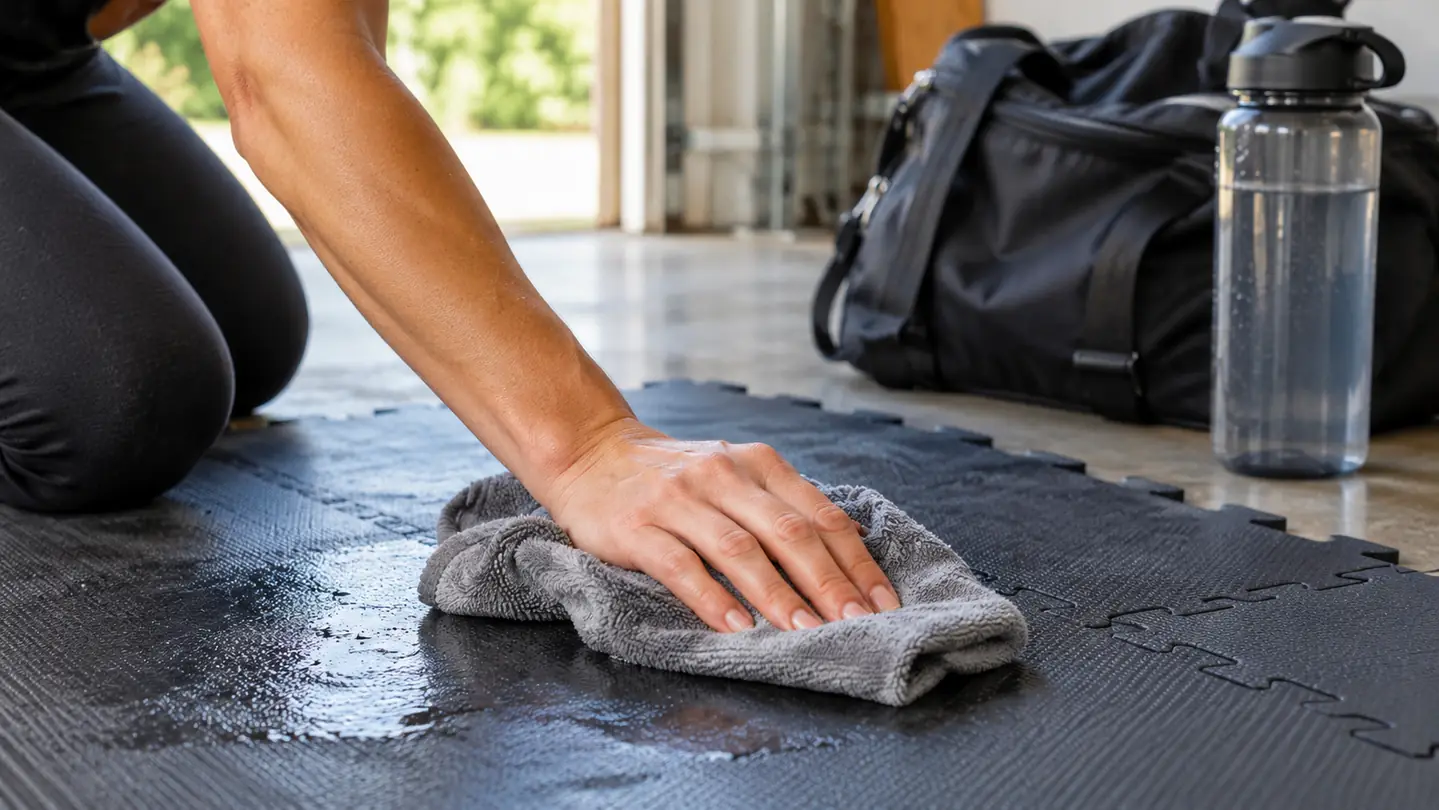
A garage floor collects everything the driveway brings in, plus everything you leave on it. I wipe the ProsourceFit mats with a damp cloth after most sessions and do a slower pass once a week. The care instruction is to air dry, so I do not soak them. Sweat, dust and chalk all come up. This matters more than people admit, because a mat you cannot clean in two minutes is a mat you quietly stop cleaning.
The surface grips when you push off it
The listing calls the foam non-skid, and in practice that means I can do lateral footwork, pivot on the ball of my foot and push into a stance without the floor sliding away underneath. I am not making a claim about grip in every possible condition. I am saying that on dry garage concrete, in shoes and barefoot, the tiles hold where I put them.
It takes the sharp edge off heavy bag noise
A bag swinging over bare concrete sends a slap through the whole garage and into the house. Foam under the bag area and under your feet softens that considerably. My family stopped noticing early sessions, which is its own kind of training benefit. It is not soundproofing and I would not sell it as that. It is a dampener, and a dampener is what a shared wall actually needs.
The end borders finish the perimeter so nothing catches
Every pack includes end borders for the outer edge of the layout. That looks like a minor detail until you have lived with a floor that has no borders and spent two years stepping on a jigsaw lip in socks. The border squares the edge off, keeps the last row from being a trip hazard, and makes the whole area look deliberate rather than improvised.
The floor comes up when the garage needs to be a garage
This is the real reason these tiles are in my garage instead of a glued down floor. When the minivan needs to come in, or when I am hauling bags and moving racks, the tiles stack in the corner. Down in ten minutes, up in ten. Two years of that cycle and the locking edges still line up. ProsourceFit lists it with a limited lifetime warranty, which is a fair statement of how they expect the material to hold up.
What I'd Skip
What I would skip is using these for anything they were not built for. I do not throw anyone on this floor. Takedowns and hard falls happen at the club on thick jiu-jitsu mats, and a half inch of EVA is not a substitute no matter how well it locks together. I also would not drop loaded dumbbells on it, drag a loaded sled across it, or leave it in a garage that takes on water every spring. And if what you want is one seamless permanent surface with no edges at all, skip tiles and buy a rolled floor. The honest summary is that ProsourceFit puzzle mats are the right mat for footwork, bag work, stretching and bodyweight training on a hard floor, and the wrong mat for impact. Buy them for the first list and rent time on real mats for the second.
Twenty four tiles, two years, one damp cloth a week, and the floor under my heavy bag is still the floor I train on.
Start with one pack and see how your knees answer
Twenty four square feet covers the space in front of a bag or a bench. Add from there once you know how you actually use the room, not how you think you will.
Amazon Check Today's Price on Amazon →