
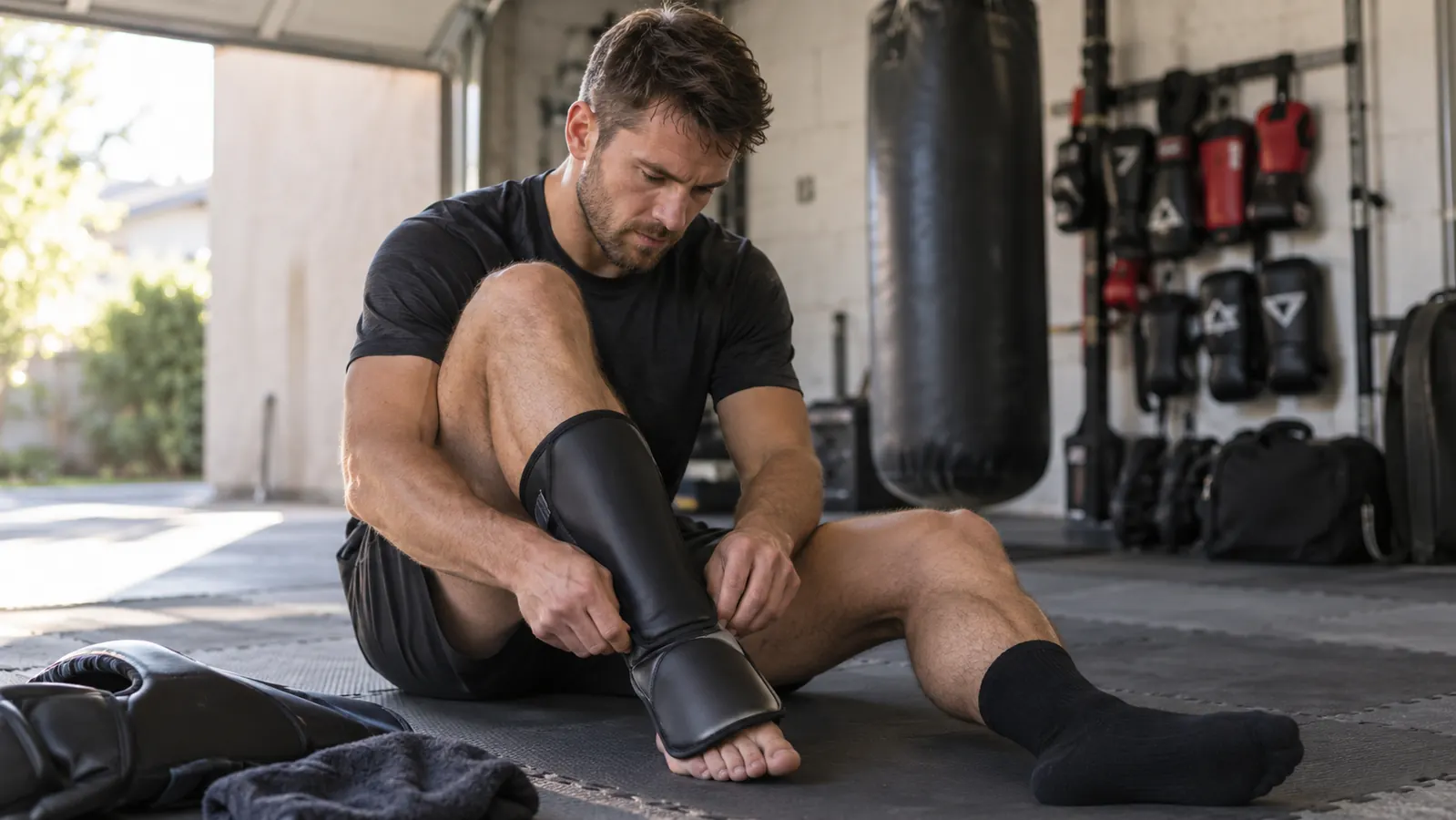
Ten months ago I bought a pair of Meister elastic cloth shin and instep guards for one reason. A parent in my kids class asked me what to buy for her son's first month of kickboxing, and I did not have an honest answer. I had worn hard-shell guards for so long that I had stopped thinking about the question. So I ordered a pair, wore them myself for a few weeks, then passed them around the adult class for technical sparring and handed them to two beginners in the kids class. Roughly forty adults and twenty kids come through my club in Columbus, Ohio, so there is no shortage of legs to test a guard on.
Here is the short version, and it is not the version the product photos imply. The Meister guards are comfortable in a way that hard plastic is not, they stay exactly where you put them, and after ten months of club use nothing on them feels cheap. They are also thin foam in a cloth sleeve. The day you start throwing hard kicks or checking hard kicks, you will feel it. What follows is what I would tell a student standing in front of the gear rack, which is a more useful answer than a star rating.
I have no sponsorship and no reason to flatter this brand. I run a small club, I buy gear out of the same budget as my mats and my heavy bag, and when something fails I stop recommending it. The reason I am writing this at all is that I got tired of telling beginners to buy the most protective guard on the shelf when what they actually needed was the one they would keep wearing past week three.
The Quick Verdict
A light slip-on guard that is genuinely good for drilling and controlled sparring, and genuinely not enough for hard contact. Buy it for your first year or two, not your last two.
Amazon Check Today's Price →The pair I hand a beginner on their first night
Slip-on elastic cloth, a padded instep, and a hook and loop strap at the top so it does not slide down mid-round. It is the guard I put on a new student before I trust them with anything harder.
Amazon Check Today's Price on Amazon →How I've Used Them
I train early mornings in my garage before the club opens, on interlocking foam mats, with a heavy bag hanging off a beam and a wall rack for gear. The Meister guards have been in that rotation for about ten months. I wear them for kick drills, for bag work on days when my left knee is complaining, and for technical sparring in Tuesday and Thursday adult class. That left knee has an old meniscus injury from my competition days, and it is the reason I care more about shin and knee protection now than I did at twenty five. When my shin is covered, I check kicks with more confidence, and a coach who hesitates on a check teaches hesitation.
I also lent them out, which is the more useful test. A guard that fits me at about 185 pounds is not the same guard that fits a 130 pound student or a twelve year old. Six different people wore this pair over the ten months, some of them twice a week. Nobody complained about sliding, which is the failure I half expected. Two people complained about the strap, which I will get to.
Care was hand washing in cool water and air drying, which is what the material wants. Roughly twenty washes across the ten months. No stitching has opened, the foam has not gone crumbly, and the elastic has not gone slack. That is a better durability record than I expected from a guard in this range, and it is the part that surprised me.
What the Elastic Cloth Actually Does Well
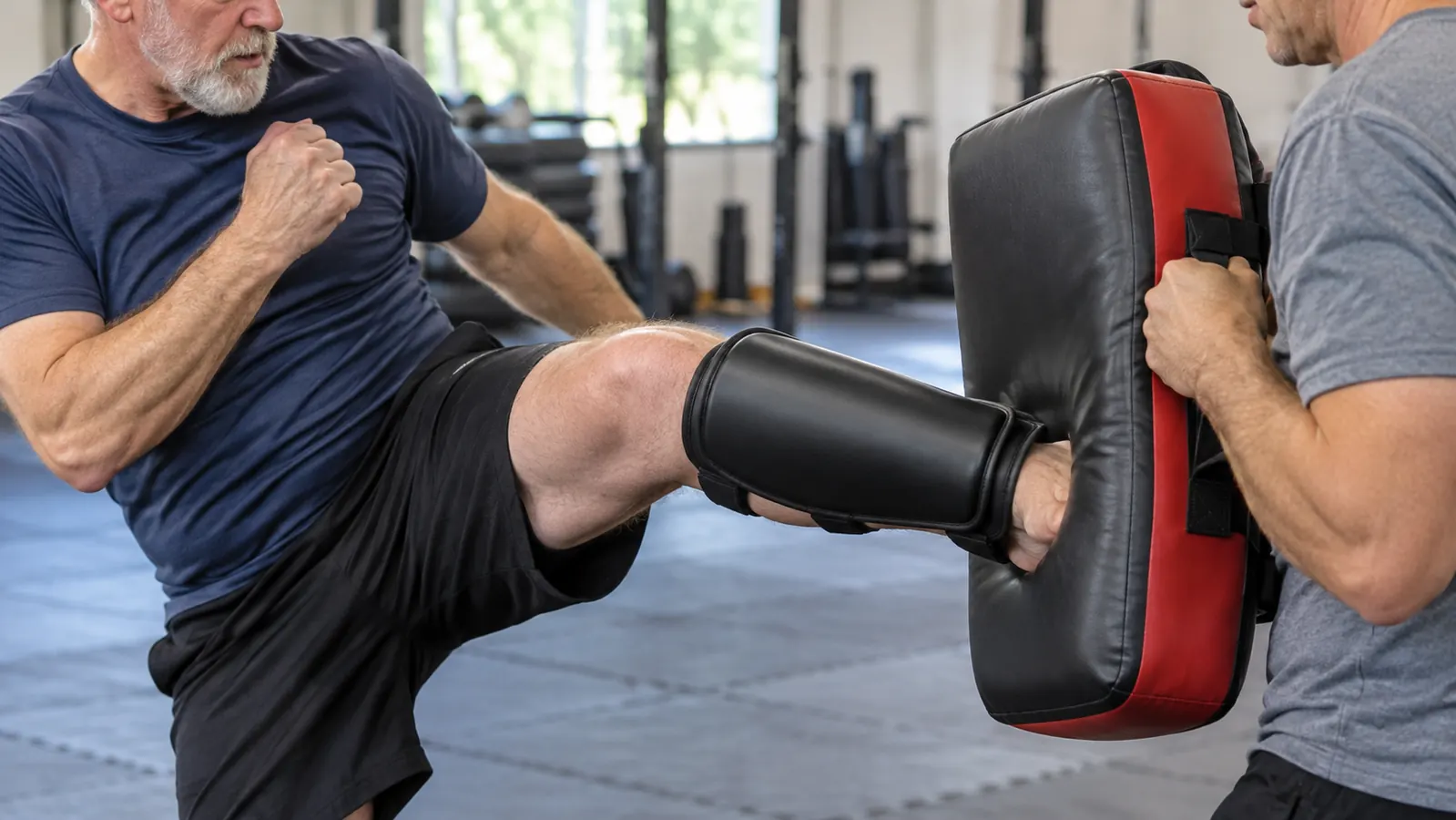
The whole body of the guard is elasticated cloth wrapped around foam, so it stretches to the leg instead of hanging off it. That one design choice explains most of what is good here. There is no plastic shell to gap at the calf or dig into the ankle when you point your foot. If you have ever worn a hard-shell guard that fit fine standing still and then shifted the moment you threw a roundhouse, you know the exact problem this solves.
Because it is cloth, it breathes and it does not clatter. I can wear these for a full hour of drilling without my shins turning into a swamp, and I can work with a partner without the plastic-on-plastic noise that makes everyone in the room look over. In a beginners class, where half the room is already self-conscious, that quiet matters more than it sounds.
The instep padding is the part I underestimated. It is a padded panel over the top of the foot, and it stays over the top of the foot as you move. When I hold pads for a student and they misjudge the distance, my foot is not the thing that takes the hit. The same holds in reverse when I am the one kicking and I catch an elbow on the way through.
The other thing worth knowing is that the whole guard weighs almost nothing. The pair is listed at 9.6 ounces, and that matches what it feels like in the hand. In a gear bag it disappears. On a leg you forget about it, which is the highest compliment I can give a piece of protective gear.
Where the Foam Runs Out
Here is the part the listing will not tell you, and the part I would want to know. This is foam in a cloth sleeve. It is not a hard shell and it does not pretend to be one. Under a hard kick, the foam compresses and you feel the pressure come through it. Under a checked kick, you feel a lot more than pressure.
The line for me is intensity, not experience. Technical sparring at maybe forty percent, working combinations, drills where contact is controlled, all of that is fine and honestly better than fine. Anything where a training partner is genuinely trying to put a kick through the pad you are wearing, and these stop being the right tool. I took one hard check in them by accident and did not repeat it on purpose. My shin was sore for two days and I had nobody to blame but myself.
Compare that to a hard-shell guard, which spreads the same impact across a rigid plate and a wider area of the leg. There is a real tradeoff and it runs the other way on comfort. Hard shells are heavier, hotter, and they fit worse. If you are sparring hard, you accept all of that because the protection is the point. If you are not sparring hard, you do not need to accept it, and most people reading this are in the second group without knowing it yet.
Before You Buy, Answer One Question
The question is not which guard is best. It is what your hardest session of the month actually looks like. If a hard session means combinations on the bag and controlled rounds where you and your partner are both pulling your kicks, then you are describing the session this guard was built for, and it will do that job for years.
If a hard session means a round where your partner is genuinely trying to put a kick through your shin, then you are describing a different guard, and no amount of liking the Meister guards changes the physics. Foam is foam. It compresses, it transfers force, and it recovers. The people who get hurt in guards like this are the ones who expected a shell and got a sleeve.
I would also ask whether you have ever worn a hard-shell guard for a full hour. Some people cannot and will not. Those people quit training long before they reach the sessions where a hard shell would matter. A guard you actually wear beats a guard you leave in the car every Tuesday.

The Strap, the Sizing, and the Small Annoyances
Each guard has a hook and loop strap at the top. That strap is what keeps the guard from sliding down your leg during a round, and it mostly works. On my legs, at about 185 pounds, I tighten it once and forget it exists. On two of the thinner students in the adult class, the strap ran out of adjustment before the guard felt locked in, and it loosened a couple of times during hard drills. Not enough to stop training, enough to be irritating in the middle of a round.
Sizing is the thing I would pay attention to before ordering. These are a slip-on, so the fit comes from the elastic rather than from a wrap or a lace. If you are right at the top of a size, going up is usually the safer call because the cloth will stretch to you anyway. If you have very thin calves or very thick ones, order with the expectation of an exchange rather than being surprised by one.
The other small annoyance is putting them on. There is no zip and no wrap, so you pull them over your foot and up your shin like a sock. That takes a few seconds longer than a strap-on guard, and if your feet are sweaty after a round it is a slightly undignified few seconds. It is a fair trade for a guard that never shifts once it is on, but it is still a trade and you should know it going in.
Ten Months In: What Has Worn and What Has Not
I expected the elastic to go first. It has not. The cloth still holds its shape and the guards still sit where I put them. I expected the strap to fray where it meets the cloth. So far it has not. What I have seen is the foam settling slightly under the ball of the foot and across the shin bone, which is normal for foam and not a defect you can complain about.
Washing is simple and I would not complicate it. Hand wash in cool water, no machine, no dryer, air dry. Heat is what kills elastic and foam, so keep both away from it. Mine live on the wall rack in the garage and dry overnight. If you throw these in a dryer you will get a guard that fits a smaller leg by spring, and you will blame the product for it.
The honest summary of the ten months is that the cloth and the stitching have held better than the foam. That is exactly what you would predict if you thought about it. Cloth and elastic fail slowly and visibly, so you see it coming. Foam fails by going soft where you load it, and you only notice because the guard feels thinner over the shin bone than it used to in the spring.
Ten months, six different people, roughly twenty hand washes, and the elastic and stitching are still doing their job. The foam is what sets the limit here, not the build.
What I Liked
- Slip-on elastic cloth stays put through kicks, with no shifting or gapping at the calf
- Padded instep panel that covers the top of the foot and stays there as you move
- Hook and loop strap at the top holds the guard in place through a full round
- Light enough and breathable enough to wear for an hour of drilling without heat buildup
- Ten months of club use and roughly twenty hand washes with no stitching or elastic failure
Where It Falls Short
- Foam in cloth rather than a hard shell, so hard checks come straight through
- The top strap runs out of adjustment on very thin legs
- Pulling them on over a sweaty foot takes longer than a wrap style
- Not the right guard for anyone sparring at real contact
Who This Is For
If you are in your first year or two of kickboxing, Muay Thai, or MMA, and most of your training is drilling, pad work, and controlled sparring, this is the guard I would hand you. It protects the shin and the instep, it stays in place, and it does not punish you for wearing it. I have put this exact pair on students in their first month and none of them took them off early, which is the whole test.
It is also the right call for a kids class, with the sizing caveat above. My son Mateo is twelve and in the kids class, and light foam matches the contact level there, which is close to none. And it makes a sensible second pair for an experienced person who wants something for light days, technical rounds, and travel, when a hard shell is more than the session actually needs.
Who Should Skip It
If you are sparring at contact, skip it. If you are training for a fight, skip it. If your coach has you checking hard kicks this week, skip it and get a hard shell. I say that as someone who likes these guards and keeps a pair in his own bag. The Meister guard is honest about what it is, and what it is, is a light guard. Asking it to be a heavy one is how people end up with a bruise they blame on the brand.
It is also not the answer if your main worry is your knee rather than your shin. The padding covers the shin and the instep, and that is the entire job. My left knee still gets its own separate protection, and no shin guard ever changed that for me.
The guard to start in, not the guard to fight in
Elastic cloth, a padded instep, and a hook and loop strap at the top. Ten months in my club and this is still the pair I reach for on drilling days. Know what it is and it will serve you well.
Amazon Check Today's Price on Amazon →