
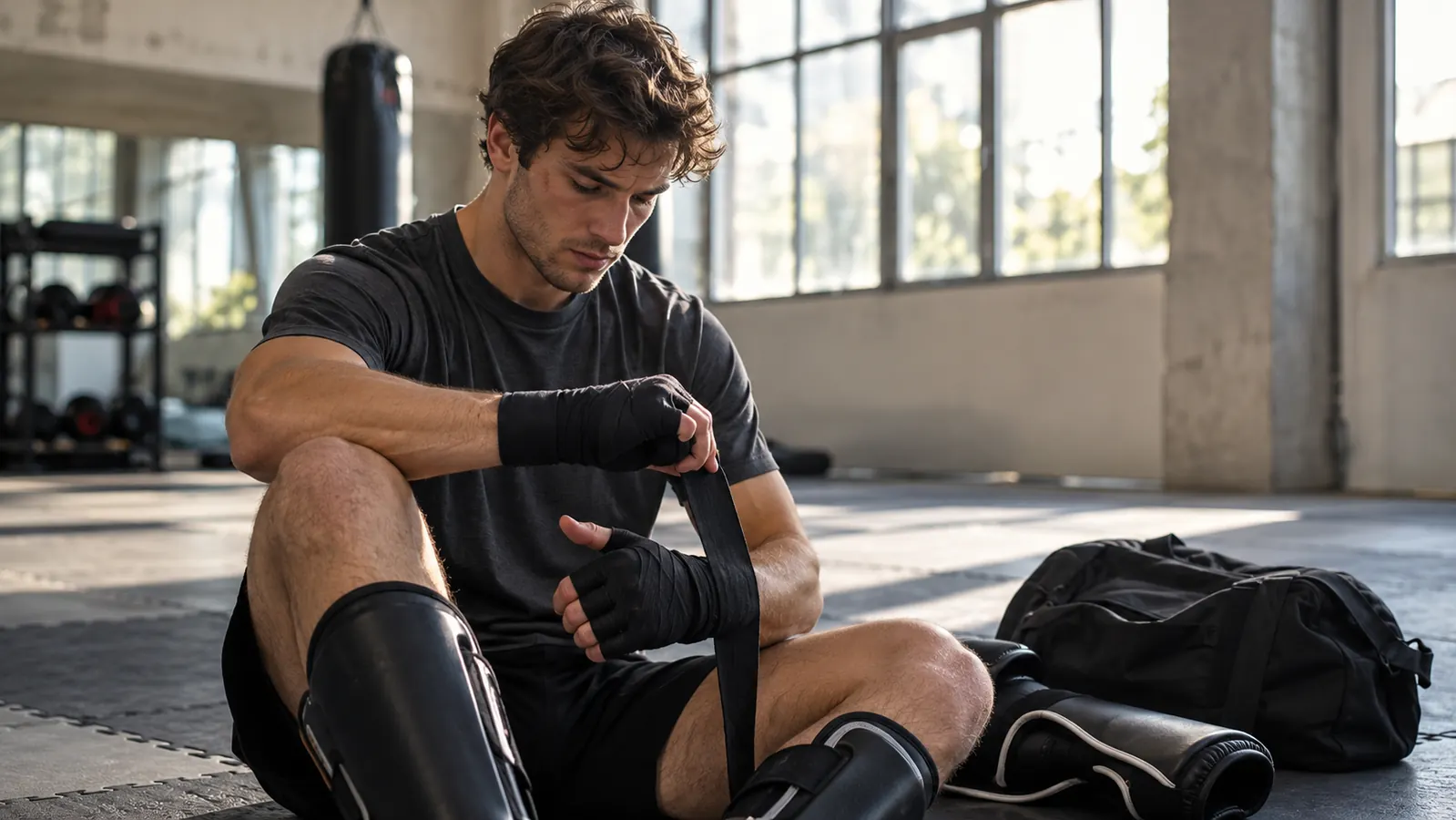
Fifteen years of coaching teaches you which gear gets borrowed and which gear sits on the rack untouched. The Meister elastic cloth shin and instep guards get borrowed. I bought my pair about ten months ago for technical sparring and kick drills at my club in Columbus, Ohio, and inside the first month two students had ordered their own. That is about the most honest review a piece of protective gear can get.
Here is the problem with most shin guard reviews. They are written after one session, by somebody who is still excited about the box. The question that actually matters is not whether a guard feels fine the first time you pull it on. It is whether it still feels fine in the fortieth class, whether the strap still grips, whether the foam has gone flat, and whether you are still reaching for it on a Tuesday night instead of digging the old pair out of the bottom of the bag. This is what ten months of regular use did to mine.
The Quick Verdict
Light, comfortable, and still holding after ten months of class use. Not a hard-contact guard, and the instep padding is thinner than the shin.
Amazon Check Today's Price →The pair I still reach for on drill nights, ten months in
Foam padding, elastic cloth body, hook-and-loop strap at the top of each guard. They go on in seconds and stay where you put them.
Amazon Check Today's Price on Amazon →How I've Used It
I run a small mixed martial arts club out of a converted warehouse unit, about forty adult members and twenty kids across kickboxing and Brazilian jiu-jitsu. My own training is early mornings in the garage and whatever I can steal during class. I wear the Meister guards for technical sparring, for kick drills on the pads, and for the bag rounds where I am working on my left leg specifically. I do not wear them for hard full-contact rounds, and I will explain why further down.
The timeline is simple. I bought them about ten months ago. They have been on my legs for two classes a week on average, sometimes three when we are running a fight camp block, plus the odd garage session on the mats. I hand-wash them every few weeks in cool water with a little mild soap, press the water out, and hang them over the wall rack to air dry. I have never put them in a machine. That routine matters, because sweat left sitting in foam is what destroys most padding long before the stitching goes.
Size matters more than people expect with an elastic guard. There is no shell to adjust and no lacing to tighten, so the elastic body has to be close to right on the first try. I am about 185 pounds with fairly standard calves, and the regular size sits snug at the top of the calf with the strap doing the last of the work. Two students of mine with much bigger calves found that same size uncomfortably tight across the widest part, and one of them sized up rather than fight it.
My left knee has an old meniscus injury from my competition days, and the left shin is the one I am most careful with. When we drill checks, the guard takes the impact on the front of the shin and the instep rather than my knee, which is the whole point. The padding over the shin bone is the part I care about most. The instep padding is thinner, and that is where I notice contact.
What the Elastic Cloth Construction Actually Means
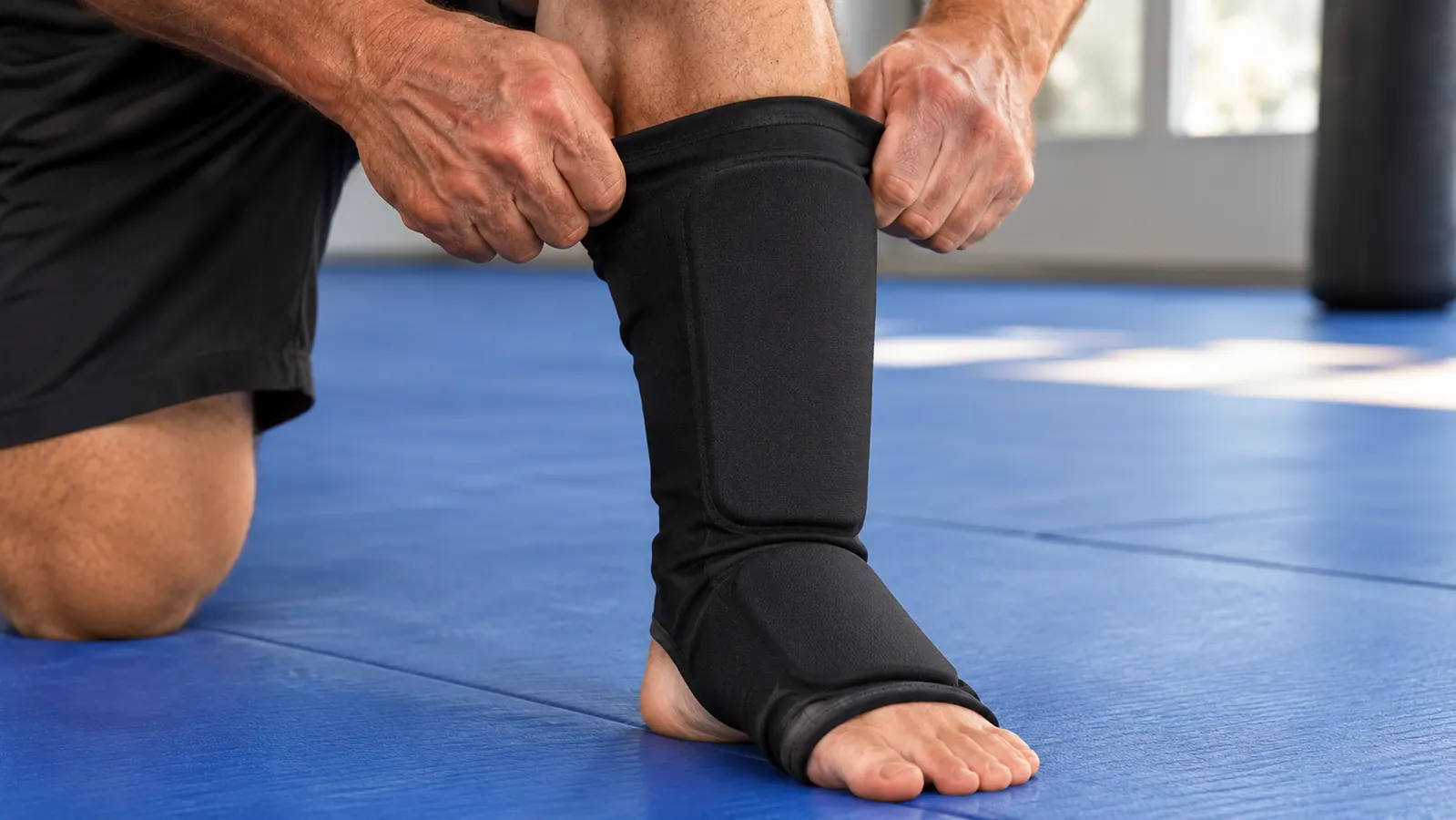
Strip it back and this is a foam guard held against your leg by an elastic cloth sleeve. Meister lists the material as foam, the closure as hook-and-loop, and the weight at 9.6 ounces for the pair, which is light enough that I forget I have them on between rounds. There is no hard plastic shell, no articulated plate, no gel insert. What you get is a padded sleeve that slides on, an elasticated body that adapts to the shape of your leg and foot, and a strap at the top of each guard that stops the whole thing sliding down your calf.
That last part is the design decision that makes or breaks a guard like this. An elastic sleeve on its own will creep down your leg the moment you start throwing kicks. The hook-and-loop strap at the top is what holds the position. On my pair the strap still bites after ten months, though the elastic in the tab has softened a little and I now set it about a finger wider than I did at the start. That is normal wear, not a failure.
What the cloth body does well is conform. Hard-shell guards sit off the leg with a liner, and you can feel the gap when you check a kick at an odd angle. The elastic here wraps the shin and the instep together as one piece, so the padding stays where you put it. It also means the guard moves with your ankle instead of resisting it. For kick drills and technical sparring, that is exactly what I want.
How They've Held Up Over Ten Months
Ten months is long enough for the honest answer. The stitching along the seams is intact on both guards. The elastic has relaxed slightly, mostly around the ankle opening, and the foam over the instep has compressed into the shape of my foot. The shin padding is still doing its job. There is a small bald patch on the inside of the left guard where the cloth has pilled from rubbing against my leg, but nothing has split and nothing has torn.
The strap is the part I expected to fail first, and it has not. The hook side still grabs, the loop side still holds, and the only change is that the elastic tab has stretched enough that I notice it when I first pull it tight. I would guess I have another six to twelve months of twice-weekly use before I replace them, and I will replace them with the same pair rather than shop around.
Washing is where cloth guards usually die. If you throw foam into a hot machine and then into a dryer, the padding will crumble and the elastic will go slack. I wash mine by hand in cool water, press the water out rather than wringing hard, and hang them to dry overnight. Ten months in, they do not smell and the foam has not gone brittle. That is not an accident.
The area I watch most closely is the seam where the instep meets the shin panel, because that is where the guard flexes every time you point your foot. On my pair it has held without a loose thread. If you kick with the top of your foot a lot, that seam is doing more work than the rest of the guard, and it is worth checking it every couple of months even when nothing looks wrong yet.
In Class: Checks, Drills and the Left Shin
Most of my use is in a class setting, with students who are learning to check kicks and learning to throw them without hurting each other. The guard takes repeated low-grade impact rather than one big one. On the pads, the shin padding is thick enough that I can drill round kicks for twenty minutes without bruising. On the bag, it is the same story. Where I notice a difference is in the instep, which is covered but thinly, so a mistimed kick that lands with the top of the foot reminds me that this is padding and not armor.
The strap position is what makes them work in a class. I have watched students with loose guards spend a whole round hitching them back up, and that is a distraction you do not want when somebody is throwing at your head. The Meister strap sits high on the calf, above the widest part, and the guard stays put through a full round of drills. I check mine once between rounds out of habit, not out of need.
For the kids class, I do not lend these out. Mateo, my twelve-year-old, uses a smaller hard-shell pair for his kickboxing class, because I want a shell on a beginner who is still learning distance. The Meister guards are what I hand to an adult who has some control and wants to drill without shin pain the next morning.
What I Liked
- Slides on in seconds and stays put through a full round of drills
- Light at 9.6 ounces for the pair, easy to forget you have them on
- Elastic cloth body conforms to the shin and instep instead of sitting off the leg
- Hook-and-loop strap at the top of each guard still grips after ten months
- Hand-washed and air-dried, the foam has held without going brittle
Where It Falls Short
- No hard shell, so it is not a guard for full-contact rounds
- Instep padding is noticeably thinner than the shin padding
- Fit is unforgiving between sizes because the top strap is the only adjustment
- Needs hand washing and air drying, and a machine will shorten its life
Ten months, roughly eighty classes, and the strap that holds the guard at the top of my calf still grips. The foam over my instep has compressed into the shape of my foot, and neither guard has split a seam.

Where They Come Up Short
Two things matter more than the rest. The first is hard contact. This is a cloth guard, and against a hard shin with full power behind it, foam compresses and then it hurts. I do not wear these for full-contact rounds and I would not put a fighter in them for a bout. If your training includes heavy competitive sparring, you want a hard-shell guard with a proper plate, and I would rather say that plainly than sell you the wrong thing.
The second is sizing. Because the whole guard is elastic, there is no adjustment beyond the strap, and a size that is slightly off will either pinch across the calf or bunch at the ankle. Order based on the calf measurement in the size chart rather than your shoe size, and if you are between sizes, go up rather than down. I have seen more people unhappy with the fit than with the padding.
A third, smaller complaint. The instep coverage is thinner than the shin coverage, and the top of the foot is where I feel contact most. That is a tradeoff for flexibility and weight, and I understand why it is built that way, but if you have had a foot or instep injury, it is worth knowing before you buy.
I tried the club's hard-shell guards first, and they are the right tool for full-contact work. The problem for me was the bulk. They sit further off the leg, they are heavier, and for a Tuesday night of technical drills they felt like overkill. I also looked at leather striking guards, which are excellent but heavier again and need more care than I want to give a piece of gear that lives in a bag.
The elastic cloth guard sits in a different slot. It is light, it packs flat, it goes on in seconds, and it is comfortable enough that I forget about it. For a coach who spends as much time holding pads and demonstrating as he does sparring, that is the balance I wanted. I wrote more about the direct tradeoff in my comparison of elastic and hard-shell guards, but the short version is that they solve different problems.
Who This Is For
This is for the adult student who drills two or three times a week, wants shin and instep coverage without bulk, and is not doing hard competitive rounds. It suits kickboxing and Muay Thai classes where the sparring is technical, and it suits coaches who are on their feet holding pads for an hour. It also suits anybody who has struggled with hard-shell guards rubbing or sitting off the leg, because the elastic body solves that specific problem.
It is also a reasonable first guard for a teenager or an adult who has just started and does not yet know whether they will stick with striking. It takes up less space in a bag than a hard-shell pair, and it does the job for the kind of controlled drilling a beginner actually does. If your class spends most of its time on stance, footwork and slow partner drills, you will get a lot out of these and you will not be thinking about them once the round starts.
Who Should Skip It
Skip it if you spar hard. Skip it if you are preparing for a fight, if your rounds include heavy leg kicks at full power, or if you have had a shin or instep injury that still flares. In those cases a hard-shell guard with a proper plate is the right purchase, and the extra bulk is part of the deal. Skip it too if you want to throw your guards in the washing machine, because the foam will not survive that habit for long.
Skip it if you are between sizes and cannot measure your calf accurately, because the fit is the whole guard. And skip it if you want one pair to do everything, from bag work to full-contact sparring. No single guard does both well, and this one is honest about which side of that line it sits on.
Ten months of class use, and they are still the pair I grab
Elastic cloth body, foam padding, hook-and-loop strap. If your training is technical drills and controlled sparring, this is the guard that disappears on your leg.
Amazon Check Today's Price on Amazon →