

Monday and Wednesday are no-gi nights at my club. Two hours of drilling, positional rounds, then live rounds until the timer runs out. Nobody is wearing a jacket to grab, so the shirt on your back is doing three jobs at once: it has to stay where you put it when someone has a handful of your sleeve, it has to survive being pulled on, and it has to stop being a wet towel by the third round. That is the only test I care about, and it is a far harder test than anything a baselayer gets in front of a gym mirror.
About eight months ago I bought two LAFROI long sleeve compression rash guards, mainly because I wanted a baselayer I could rotate without paying purpose-built grappling shirt money for both. The listing is honest about what the garment is: LAFROI sells this as a multi-sport UPF 50+ baselayer, listed for boxing, MMA, jiu-jitsu, kayaking, indoor sports, outdoor work and daily wear. It is not marketed as a shirt built only for the mats. I went in expecting a sun layer that could survive a roll. Eight months later one of the two is still in my Monday rotation and the other lives in my gear bag as the spare. Here is what held, what did not, and who I would hand one to.
The Quick Verdict
A slim, light UPF 50+ baselayer that took eight months of no-gi without losing its shape. The cuffs and the print are the honest weak points.
Amazon Check Today's Price →Two shirts, sixty-eight classes, no hole in either one
The LAFROI baselayer I keep reaching for on no-gi nights. Slim fit, crew neck, long sleeve, listed at 0.2 kg.
Amazon Check Today's Price on Amazon →How I've Used It
I run a small mixed martial arts club out of a converted warehouse unit, roughly forty adult members and about twenty kids split across kickboxing and jiu-jitsu. I am 44, about 185 pounds, brown belt, and I carry an old left-knee meniscus injury from my competition years that decides how much guard work I do on any given night. I ordered both shirts in large. Two shirts across roughly 68 no-gi classes over eight months means each one has been through about 34 live sessions, plus whatever I put them through in my garage before the club opens.
The care routine is not fussy, which matters to me because I am not going to baby a training shirt. They get washed cold with the rest of the gear and hung on the rack in the garage to dry. No dryer, not because the label demands it but because I hang everything and the rack is right there next to the heavy bag. That routine has been identical for eight months and neither shirt has pilled, shrunk noticeably, or come out of the wash a different shape than it went in.
Before these, I wore plain cotton t-shirts to no-gi for years, and I knew exactly why that was a bad idea. Cotton holds water, so by the third round it weighs twice what it did at the start and it stays wet against your skin for the drive home. I tried an old running compression layer for a couple of months before that. It stayed light, but the fit was loose at the waist and the collar had stretched out within six weeks of collar ties, which meant I was tugging it back into place mid-round. That is the specific job the LAFROI shirt had to do better. It did it in the first session: nobody had to fix their own shirt, and nothing needed adjusting between rounds.
For context, I spend two hours a night looking at what forty other adults are wearing on the mats. Most of them are in purpose-built jiu-jitsu brands with the grippy hems and the heavy collars. The LAFROI shirt does not feel like those. It feels lighter and thinner in the hand, more like a compression layer for running or paddling, and the first week I kept waiting for that lightness to turn into a problem. It did not. That is the whole reason I am writing this instead of just retiring them quietly.
How the Fabric Handles a Real Round
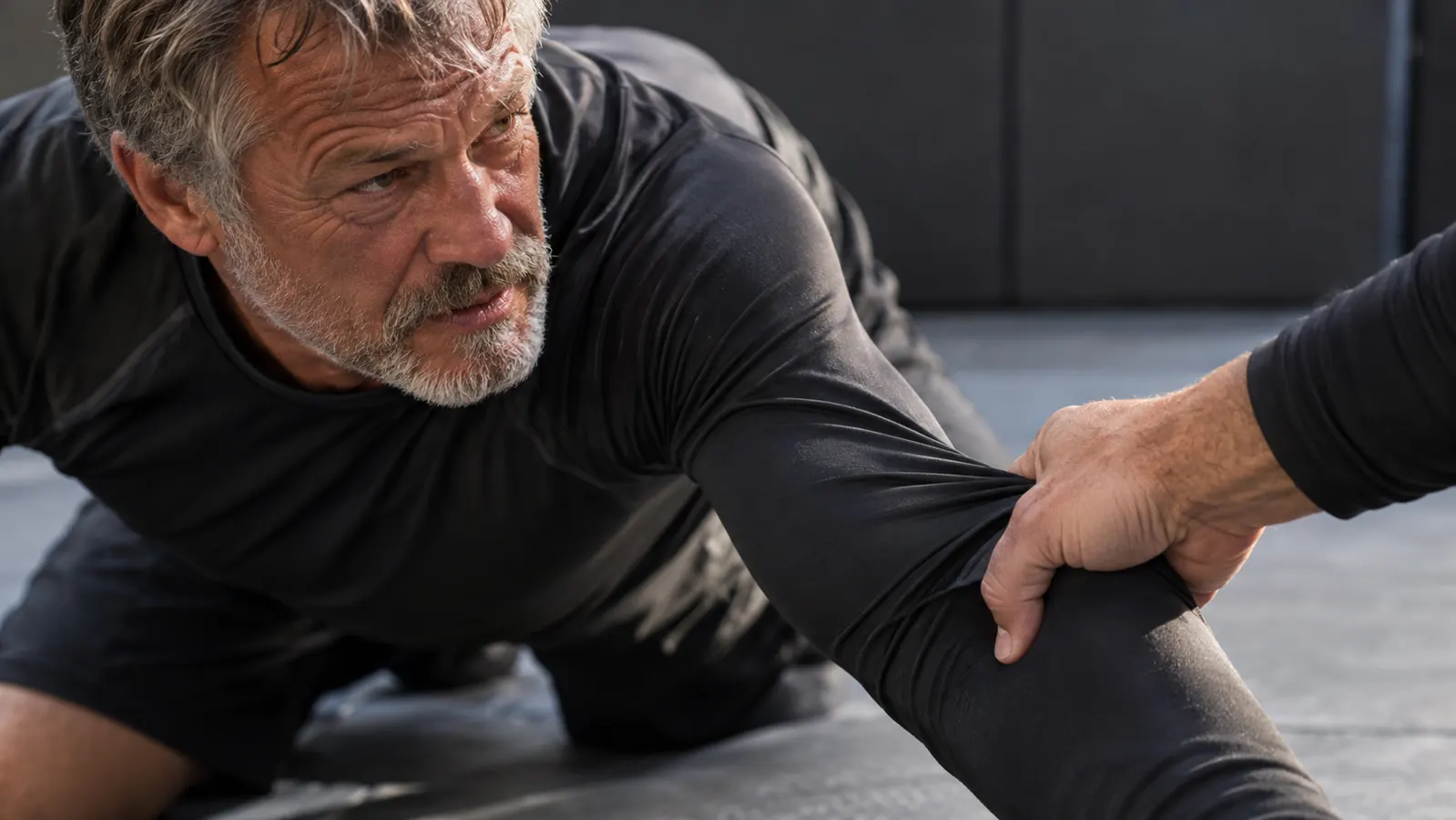
The fit is listed as slim and performance fit, and that is accurate. It sits tight through the chest and shoulders without restricting how far I can reach, which is the line a compression shirt has to walk. The long sleeve stays at the wrist through grip fighting instead of sliding up to the elbow halfway through a round. There is no bunching under the armpit when I frame, and nothing rides up over the belt line when someone drags me down, both of which are the two failure modes I notice first in a cheap baselayer.
On sweat, it behaves the way a thin baselayer should. It gets soaked, same as everything else on the mat, but it does not hang heavy and it does not stay cold and clammy the moment the round stops. Back on the rack in the garage it is dry well before the next morning. It also comes out of the wash smelling like nothing, which I cannot say for every synthetic shirt I have retired early over the years.
One night in the middle of a positional round I spent four minutes with a training partner on my back, both of us fighting for my collar and my sleeves. That is the round that tells you whether a baselayer has anything in it. The fabric slid when I wanted it to slide and held when his hand closed on the sleeve, and it did not stretch out at the shoulder the way a cheap knit does after ten minutes of that. When the timer went, the shirt was wet through and still sitting exactly where I had put it that morning. I have had that same round ruin a shirt inside a month.
The UPF 50+ rating is the part I did not expect to use. I wear these for outdoor conditioning in the summer and for the walk between the unit and the van when I am hauling gear, and a long sleeve that is listed at UPF 50+ means I stop thinking about my arms burning on a July afternoon. That is a genuinely useful second life for a shirt that spends its winters being grabbed.
Fit, Sizing and the Crew Neck
Order your normal size if you want it tight and one size up if you are between sizes or hate compression. At 185 pounds the large is snug on me in the way a rash guard is supposed to be snug, and it does not leave slack anywhere for a training partner to gather up. If you are carrying more weight in the middle than I am, or if you just do not like fabric against your ribs, size up. The slim cut is the entire point of the garment, so complaining that it fits slim is like complaining that a kettlebell is heavy.
I lend gear to students constantly, so those two shirts have been on more backs than just mine. One of my adult students is around 200 pounds and a few inches taller than me, and he borrowed a large for a Tuesday class. He handed it back saying it fit like a second skin but pulled across the shoulders whenever he reached overhead. He would be an extra large in this cut. Another student, maybe 165 pounds, wore the second shirt through a full week of classes and asked me afterwards where I got it, which is the closest thing to a review I get out of that group. Neither of them reported the shirt riding up or the sleeves sliding, and both of them are rougher on gear than I am.
The crew neck has been the pleasant surprise. A crew collar on a compression shirt can gape open the first time someone gets a collar tie on you, and then it stays stretched forever. This one has held its shape through eight months and has not gone wavy at the edge. It sits flat against the collarbone, high enough that there is nothing loose to grab, and it is not so tight that it feels like a tourniquet around the throat during hard rounds.
The sleeve ends are a plain hem, with no elastic cuff and no thumb loops. On the wrist that works fine because the slim cut keeps the sleeve where it is. Over time the hem has relaxed a little, which is the one place the construction shows its limits. It is not failing. It is just not as crisp as it was in month one, and if you have long arms and rely on a tight cuff to keep a sleeve down, you will notice it sooner than I did.
Eight months, about 68 no-gi classes spread over two shirts, and neither one has a hole, a stretched collar, or a seam that let go.
Eight Months In: Wear and Tear
Here is the condition report. No holes anywhere, including the armpits and the shoulder seams, which are the two places a baselayer normally dies first when it is being pulled on twice a week. The collar is still flat. The body has softened slightly in the hand, the way any knit does after dozens of washes, but it has not gone baggy at the waist or stretched out across the back. I have retired shirts at four months that started in worse shape than these are in now.
If you want the timeline, it goes like this. The first three months nothing changed at all and both shirts still looked new. Around month four the print started to dull at the left shoulder, which is the side I get gripped from most, and the sleeve hems went slightly soft. Months five through seven were the boring stretch where nothing else happened, which is exactly what you want from a baselayer. The last six weeks have been more of the same. I have washed each shirt somewhere north of forty times now, cold, hung to dry, and the only visible change since spring is that dulling on the graphic.
The print is the part that shows age first. Mine has the dragon graphic on it, and where the mat and the shoulder of a training partner rub against it the most, the graphic has faded. It is not peeling or cracking, just losing a bit of definition in the high-friction zones. If you care what the shirt looks like after a season, buy a plain one or accept that graphics on training gear have a shelf life.
What would make me retire a shirt at this point is a seam letting go or the collar going slack. Neither has happened. If both shirts make it to the eighteen-month mark in this condition I will consider that a fair run for a baselayer that was never designed to be a grappling-specific garment in the first place.
What I Liked
- Slim performance fit stays in place through grip fighting and live rounds
- Crew neck has held its shape after eight months of twice-weekly use
- Long sleeve stays at the wrist without elastic cuffs
- Listed at UPF 50+ and 0.2 kg, so it doubles as a summer sun layer
- No holes, no seam failures, no significant shrinkage in eight months
- Thin enough to dry overnight on a garage rack
Where It Falls Short
- Plain hem cuffs relax over time, so the sleeves lose their crisp edge
- The dragon print dulls in the high-friction zones
- Slim cut leaves no room for anyone who wants a loose baselayer
- Not built with the grippy hem or heavy collar of a grappling-specific shirt
Where It Falls Short
This is a multi-sport baselayer, and it is fair to hold that against it if you want a shirt built only for the mats. There is no grippy hem to keep the shirt anchored inside your shorts, no reinforced panel stitching where a grappling brand would put it, and the collar is a compression crew neck rather than a heavier double-stitched one. None of that has mattered in eight months of my use. All of it could matter to someone rolling five or six days a week.
The other honest limitation is sizing. A slim cut means a slim cut, and there is no relaxed version of this shirt as far as I can tell. If you are broad through the chest and shoulders, the same tightness that keeps the shirt from being grabbed is going to feel restrictive in the first few sessions. Order up, or pick a different cut entirely.
Who This Is For
You should look at this if you train no-gi a couple of times a week and want a baselayer you can own two of without thinking hard about it. It suits the student who is six months into jiu-jitsu and does not want to spend grappling-brand money before they know they are staying. It suits anyone who wants one shirt to cover Monday night rolls and Saturday morning outdoor conditioning, because the UPF 50+ rating and the 0.2 kg listed weight make it a genuinely usable sun layer. And it suits the person who washes gear cold, hangs it up, and expects a shirt to last a season of twice-weekly use. I would hand one to a new student without hesitating.
Who Should Skip It
Skip it if you are on the mats five or six days a week and you want the grippy hem, the heavier collar, and the reinforced construction of a purpose-built grappling shirt. Skip it if you want a loose baselayer, because this one is slim by design and will not give you that. Skip it if graphics bother you, since the print on mine has dulled where it rubs. And skip it if you are between sizes and you know from experience that you will not enjoy a tight fit, because sizing up only buys you so much room in a performance cut.
The shirt that kept its collar when the cheap ones did not
Eight months of no-gi on two LAFROI baselayers, and the crew neck is still flat, the seams are still closed, and the sleeves still stay at the wrist.
Amazon Check Today's Price on Amazon →